
Last Updated on February 7, 2025
Do you find it difficult to budget your money – for personal use and/or for business use – for personal development even if you want to learn and grow as a person and/or you want to help your employees live a more balanced life?
From a legal perspective, the legal guardians (i.e., primary caregivers) and educational institutions are legally responsible for educating and supporting children to become adults for 18 years (depending on your local law).
In an ideal world, every adult would have sufficient knowledge and capabilities to merge seamlessly with psychosocial challenges in adulthood.
The reality is that you are now an adult, whatever your role is – a son, daughter, parent, worker, employee, owner, founder, manager, etc. – you have started to realize that the life you pictured and imagined in your head during childhood doesn’t actually exist in real life.
Some choose to live vicariously through other people’s lives, while others choose to take action.
This article is dedicated to you (an individual) who wants to learn how to budget your money on self-care and any business owner or leader who is considering incorporating personal development workshops or training into the workplace.
what early adulthood looks like for most people
Adulthood typically starts when you begin looking for a job, finding a safe space, paying bills and budgeting. Nonetheless, the first 4 to 6 years of adulthood are technically still a part of “youth”. In Canada, you are still a youth until you officially turn 31.
Why does anyone need social or professional support during adulthood?
Depending on what your regional cultures, beliefs and traditions are, you may learn your lesson the hard way. However, this may not apply to you if you still live with your primary caregivers or family members for any reason.
Legally speaking, an adult should take full accountability for all aspects of decision-making processes in life. Life is full of ups and downs. It is unpredictable and you never know what comes next. This is why you need support.
life transitions occur at any time during adulthood
This happens when life becomes more real. For instance, finding an affordable shelter and paying rent for it or saving more to own your safe harbour. Building a new safety net isn’t as intimidating as it may seem, but it is hard work even with emotional and practical support.
The truth is, your thoughts and lifestyle may deviate from your known world at any point (e.g., how you were brought up and how you used to interact with people during childhood). If you are going through this process and feel emotionally drained, you may be experiencing an identity crisis.

The financial habits among americans and canadians
People have different financial habits based on either personal preferences or organizational needs. The former is likely to be influenced by law, natural and social environments and local customs, whereas the latter is measured and evaluated by relevant shareholders and/or stakeholders.
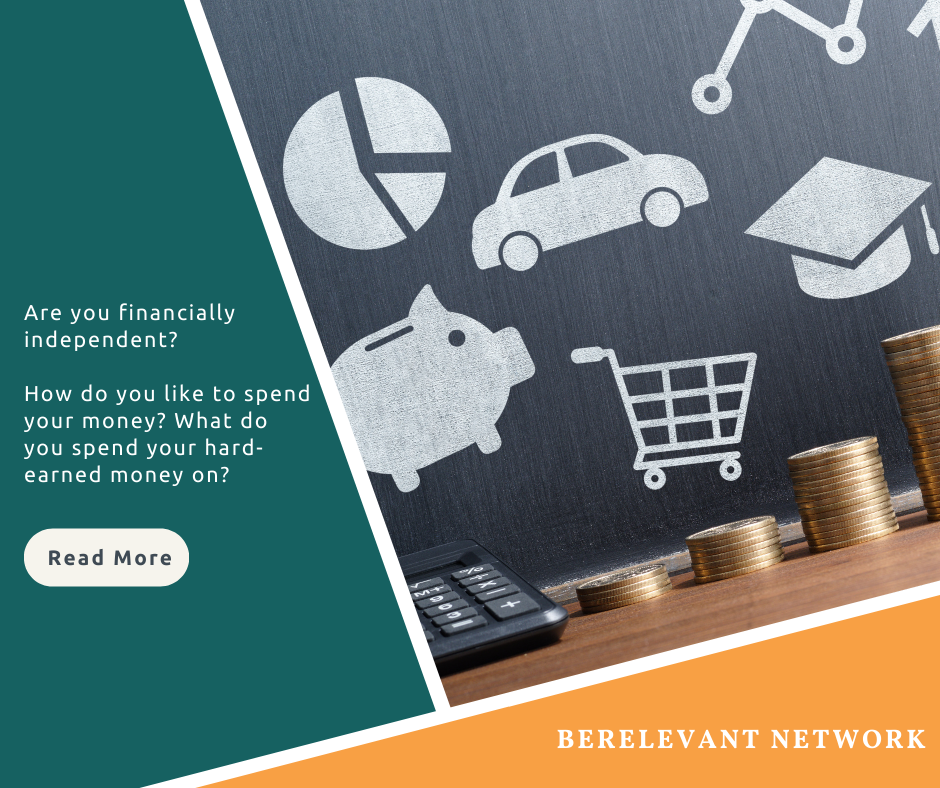
How do you like to spend your money and where do you spend your hard-earned money?
According to “The Spending Habits of Americans” published by Investopedia revealed that people spent more on food, followed by transportation (due to the call back to the office) and personal care (products and services) in 2022. The results indicated that Americans no longer prioritized “entertainment” during the process of forming a new formality.
Compared to the Americans, Canadian households continued to spend more on housing, followed by food, transportation, and interestingly, house maintenance based on Statistics Canada’s report released in 2021 (Moosapeta, 2023).
These results show that going through the pandemic and inflation has significantly changed people’s spending habits.
The definition of Spending habits
Spending habits are patterns or behaviours of how money is being distributed over a period of time by an individual or household. The way you spend money and how you live your life are usually interconnected. In an ideal situation, you would want to spend money carefully rather than impulsively.
Humans’ Basic needs
Your basic needs are food, shelter (housing) and transportation (commuting). Anything you can think of to help your body and brain function normally. While some can live without solid food (due to lack of supplies, personal choice or medical reasons), others need nutritious food to survive and stay healthy (or feel healthy).
Besides your necessities, how do you treat yourself? Would you rather spend money on entertainment or personal development? For example, would you prefer to dine out in an overpriced or overhyped restaurant, book a weekend getaway or enhance your quality of life by allowing yourself to be vulnerable?
People spend more money on self-improvement in modern times
Decades ago, when the public was fed stigmatized and prejudiced propaganda about mental health and mental illness, people were afraid to talk about their mental health and personal needs.
No one wanted to be labelled as “a wild (what it really means is “an individual who has difficulties fitting in”) person”.
Thanks to substantial precedents set by the social activists and mental health advocates, people are encouraged to speak out. However, as you know, many do not know how to convey thoughts and emotions in a respectful manner, causing other social issues that need political attention and societal change.
As a result, training and coaching services have become one of the fastest-growing industries in recent years.
What is personal development?
Personal development, self-improvement or self-care is a series of relevant activities or events offered by trained professionals, individuals (e.g., influencers), educational institutions or private companies that help cultivate an individual’s capabilities and potential. The process helps a person to build resilience; and a team to increase human capital.
Whether you are an accomplished professional or leader, spending money on personal development is much more needed than you think.
how can investing in self-care improve quality of life?
In 2023, more than 3 billion people – 15 years of age or above – were employed globally (Dyvik, 2023). Therefore, understanding the key to maintaining a healthy balance between work life and private life has become more crucial than ever.
Here are some of the simplest ways to invest in self-care:
For cost-conscious individuals:
- In your spare time, even 10 minutes a day, save it for “practicing mindfulness”
- Attend free support groups
- Find a book to read
- Join volunteering events
For businesses looking for budget-friendly options:
- Encourage your team members to take a break from work (e.g., allowing your team members to take emergency time off whenever needed)
- Find relevant resources, such as off-the-shelf workshops or reasonably priced training sessions
Please note that if your business has more capital seeds, you can consider sponsoring some or all of your high-performing teams for continuing education
Tips For Maximizing Your Spending Money On Personal Development
1. understand your spending habits
Using a spreadsheet helps you organize and track your expenses more easily. You will record every single expense weekly, bi-weekly or monthly for 12 months. Then, you should be able to see a pattern – what and where you spend money.
2. set aside some money
After deducting the cost of your basic needs, like the average cost for (nutritious) food, rent/mortgage, and transportation, you find yourself having $90 extra. You should spend money on what makes you happy (entertainment), but you can always set aside at least a quarter of your money (in this case, it would be $22.50).
If you want to attend a group coaching session, you may find an option that would cost you anywhere between $25 and $50 per session. You would be able to attend at least 1 or 2 of them each month. However, if you want to book a 1:1 session, which usually costs more, you can always look for providers who offer “half sessions“.
The same thing goes for business owners. You know what, how and why you need to spend money on item A, item B and item C. You can always cut unnecessary expenses, such as giving out bottled water and purchasing an excessive amount of office supplies. Every penny you save can go towards your future. And your future is your people.
3. stick to your routine
Once you have made a habit of spending consciously and wisely, you will understand no matter how much money you or your team earn, you can always improve your quality of life. When you do so for a week, a month and a year, you will feel the difference. You may find your new talent, be promoted or be able to provide consistent services to your valuable customers.
All in all, perhaps you can incontestably compromise on the quality of some of your necessities, you cannot gamble on your and/or your team’s well-being by cutting personal development or self-care expenses. A person’s mental well-being affects every important decision-making process and has a great impact on happiness, job satisfaction, performance and productivity.
References
Eser, A. (2023, August 14). Essential Personal Development Industry Statistics In 2024. Zipdo. https://zipdo.co/statistics/personal-development-industry/
Davis, M. (2023, October 17). The Spending Habits of Americans. Investopedia. https://www.investopedia.com/financial-edge/0512/the-spending-habits-of-americans.aspx
Moosapeta, A. (2023, October 21). How do people in Canada spend their money? CIC News. https://www.cicnews.com/2023/10/how-do-people-in-canada-spend-their-money-1040458.html#gs.73n4kv
Dyvik, E. H. (2023, November 1). Number of employees worldwide 1991-2023. Statista. https://www.statista.com/statistics/1258612/global-employment-figures/
READ MORE: Subscribe now and we will keep you updated! This is NOT an email marketing subscription.

Comments