
Last Updated on May 6, 2025
A few years ago, I worked in a government-funded employment program for people with diverse abilities. Because of the complexity of the work, in addition to my main job, I learned to write targeted resumes and prepare tailored client portfolios. My manager suggested adding several “personal attributes” to the resumes may have positive results. Furthermore, attaching professional or relevant photos to client portfolios may also attract attention and thus increase visibility.
Since we were short-staffed, I was asked to perform the marketing specialist’s job as well.
Due to confidentiality, we never mentioned the names of the service participants outside of the meeting rooms. Instead, every participant was assigned a case number, and that was how we addressed each individual in emails or via the internal messaging system.
I cannot speak for others, but I followed the guidelines strictly and always took necessary measures to protect personal information. My manager must’ve recognized my work ethic, so they shed tears when they heard I was about to relocate.
*This article is inspired by Daily writing prompt.


how identifying personal attributes can increase job sustainability
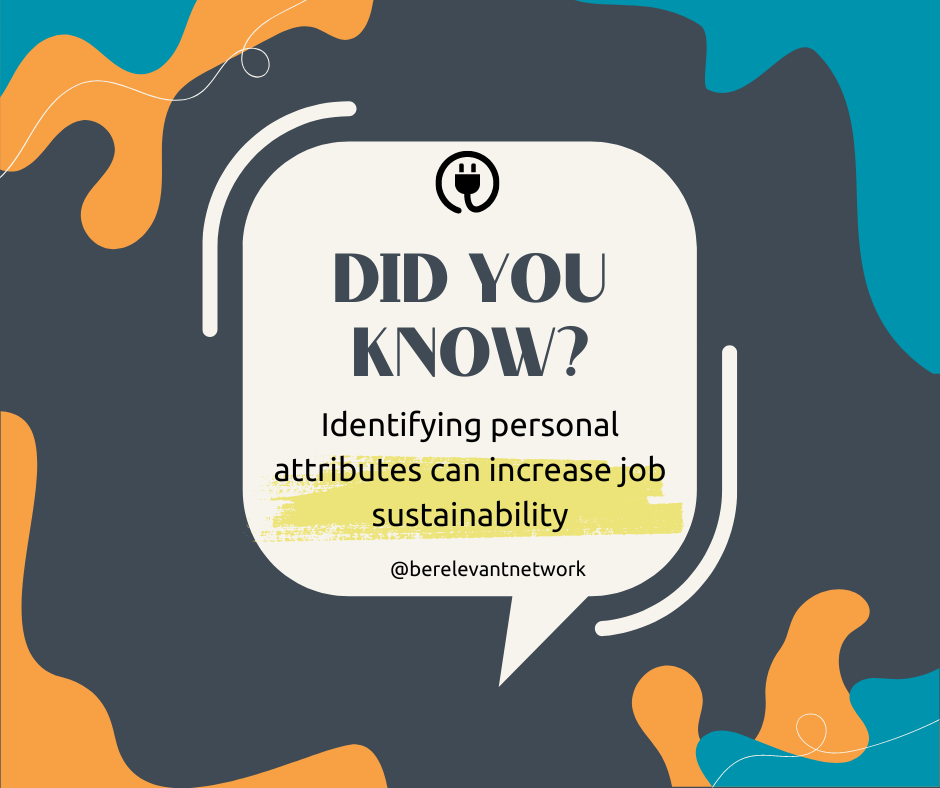
One of the most interesting yet difficult tasks while performing each vocational assessment is to determine relevant personal attributes. Personal attributes include attitudes, characteristics and traits.
For instance, if a person easily gets overwhelmed by holding a conversation or making a conversation, it probably wouldn’t make any sense to add “outgoing” to the resume. Needless to say, placing them in a mall or a sales position.
As a result, every assessment is (should be) meticulously crafted based on the strength-based approach. It is also one of my favourite approaches in terms of social work practices.
what is the strength-based approach
As far as I know, the existence of our customized employment program is to carve employment opportunities for people with diverse abilities. Thus, identifying their personal attributes is the key to each successful job placement.
The strength-based approach is quite self-explanatory. Focus on “strengths” rather than “weaknesses” of a person. Essentially, it is not about “learning what you are good at or bad at” but about “how much more you could’ve offered if you were seen differently”.
how “strength-based approach” is applied in practice
Before proceeding to the next step, I preferred to spend at least five to six hours on outings and office meetings (conducted by video-conferencing or in person). Through these meetings, I was able to observe their behaviour and learn who they are as a person. Because of the way I conducted these meetings, I was not just once praised by my manager that reading my reports and notes was like reading a story. These notes outlined a full picture of what the participant and I had accomplished together during this discovery process.
With all that being said, I am aware that not every agency requires their customized employment specialists to complete a 50-page assessment for each adult participant. I voluntarily worked overtime at times because I wanted to pair my clients with their ideal jobs (to increase job sustainability). This cannot always be achieved by working regular hours.
It came to my mind that this company was started by a social work graduate while writing this article. If I remember correctly, my boss and I were the ONLY two at that time who had direct educational backgrounds.
personal reflection: resilience is my most valued trait
Believe it or not, I was once a job hopper. During my interview for this position, of course I was tasked to answer this question. I explained how much I wanted to contribute more and prove myself with sincerity.
Having worked in a few toxic workplaces, I had no expectations prior to attending the interview with this company. I was overqualified and significantly underpaid for jobs I did in the past, so I decided to be honest about my expectations.
Ultimately, their recognition opened new doors for opportunities. I was finally seen.
What’s more, my manager and bosses never shied away from giving me compliments on my work ethic, professionalism and attitude.
conclusion
Of all my personal attributes, what’s the trait I value most about myself?
If I have to pick one trait, it has to be my “resilience”. I feel overloaded, gloomy and miserable at times just like everybody else. But, I always bounce back quickly.
No matter how stressed I felt while performing three people’s jobs, I made sure I always brought my A game to work. Because I knew I was changing lives every day. Seeing service participants and their family members’ smiley faces empowered me to give more. I may not receive excellent benefits and perks, but I was rewarded by gratitude from people.
If it weren’t for working for a company that cares about principles and employee appreciation, I wouldn’t have realized my best qualities. No one is perfect, neither is a workplace. Nevertheless, I truly felt honoured to work with some of the most interesting and talented individuals. This life experience has empowered me to become a more resilient person who is not only stronger but tougher.


Comments