
Last Updated on August 1, 2026
“That new Indian guy…”, said my life partner (see what it is like to be in a neurotypical-neurodivergent romantic relationship). “Wait, sorry to interrupt you, but how do you know how they identify themselves?” I asked. As he was contemplating the question, “Has anyone ever (in Canada) asked you where you are from originally?”, I clarified. His eyes lit up, and he responded, “You were right. No one really asked me that!”
Known for being an immigrant country, Canada is a multicultural society welcoming people worldwide to make it their new home. However, did you know many people in Canada are negatively reinforced to ask “Where are you from originally?” to avoid conflict?
*This article is in relation to Daily writing prompt.
why people ask “where are you from from?” – 3 reasons and real-life stories
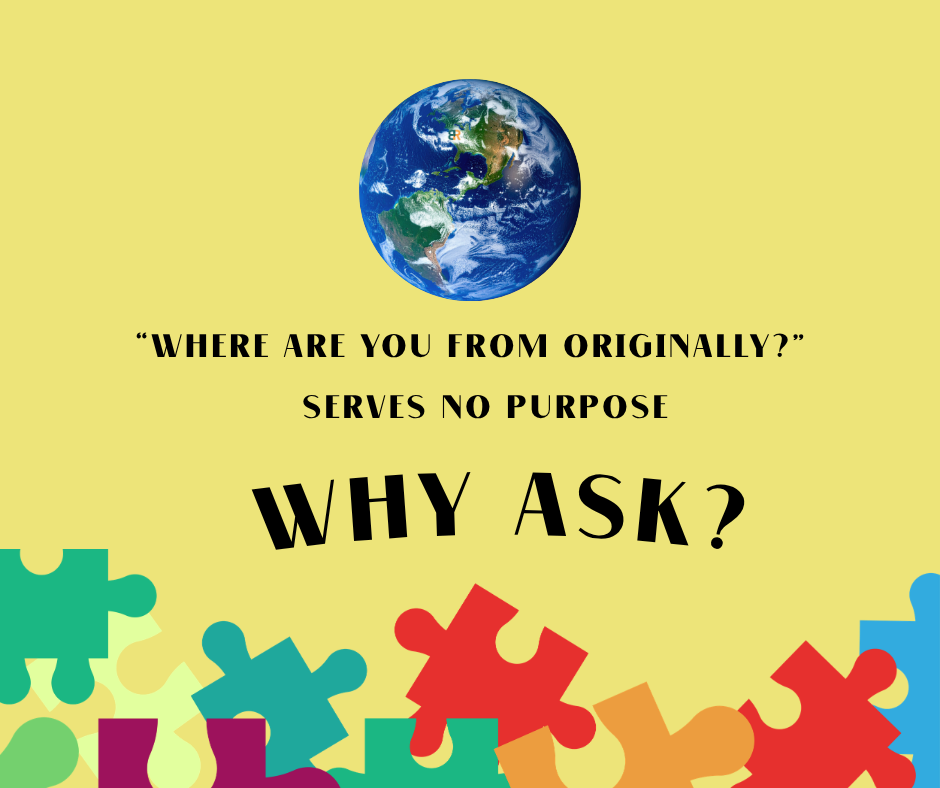
“Where are you from originally?” is one popular question in the dating world, especially amongst non-European immigrants across immigrant countries. It is a filter that absolutely serves no purpose in finding the one. Besides, it is also a part of the DEI initiatives under the current political climate, where you could opt to tick a box and get the job, literally, because of your label, not your competence. Whether it is affirmative action or the DEI initiative, its goal is/should be about bringing people closer together, yet it doesn’t seem to work. Because individuality matters.
the Fetishization of traditionally defined women of certain descent or heritage in the dating world
“I know enough about you to date you (seriously)!”said a person on our first date. They refused to go on a second or third date because they didn’t want to waste their time when they knew this was “the right” relationship. At that time, I thought it was a sign of maturity, but later, I found out the hard way that it was merely fetishization. The truth is, after a few more dates, I quickly sensed incompatibility on many different levels. The young me was not as courageous, so I just went with it.
However, I did step up in the end, “… We have cultural differences”, I said. Despite that, they did not take rejection well and continued to pursue me. Ultimately, I suggested “going no contact”, which is different from silence in a relationship, for one month. And shortly thereafter, “You are not the person I thought you were!”, they phoned to end the relationship “on their terms”.
when Cultural Appreciation becomes appropriation in the business world
Cultural appreciation frequently turns into appropriation in the business world. Although it may appear an honest mistake, such gestures serve no purpose. Years ago, I worked at an organization that celebrated Diwali. Since many staff and service participants hailed from India, the management thought it was a good deed. Shockingly, an office worker dressed up in (what they believed to be) Diwali clothing when no one else did.
They greeted everyone, making sure everyone saw their outfit, while I was just quietly observing others’ reactions. It could’ve been a great learning opportunity for those who do not share the same belief. However, the management didn’t share any background story of Diwali in writing or any other art forms. Instead, they pre-approved for a free lunch and ordered Indian-inspired pizzas. From my perspective, this is when cultural appreciation becomes appropriation.
The moral of the story is that irrespective of where a person is originally from, individuality matters. Namely, a belief system may alter due to a person’s life experiences influenced by natural and social environments. To get to know someone, being curious about a culture and embracing a learning experience is necessary. Otherwise, good intentions could eventually go wrong.
Many choose to play it safe by asking “where are you from from?”
Ramadan ended on March 19, 2026. It is a month of fasting, prayer, gratitude, self-reflection and community support. Due to political propaganda and the decline of media literacy, some believe that women in Islam are suffering and need help. But that’s not what the narrative and life experience of one of my Muslim female co-workers. They are, in fact, thriving and eventually left a survival job to practice medicine.
Furthermore, I learned from two self-identified (Boomer/GenX) Christians, one insisting that “public schools are turning kids gay”, while the other embracing all gender identities. In addition to that, I was friends with a few Muslim males who didn’t practice their religion. Meanwhile, I also personally knew those who did.
The truth is, in spite of a person’s gender identity or beliefs, studying Social Work and Behavioural Science broadened my horizon. Moreover, having been fortunate to live, play and work in a multicultural society proved pragmatically that humans are really just humans. What a person practices or believes has nothing to do with their intelligence, personality and competencies. That is, if I had chosen to play it safe, I wouldn’t have met my life partner. Despite my life partner and me’s differences (we are all different regardless of where we were born, frankly), we knew from the beginning that the most important quality of a person lies in their heart, not stereotypes.
cultural representation should never be Restricted to physical appearance
In 2023, Michelle Yeoh won Best Actress for “Everything Everywhere All at Once”. Ever since her win at the Oscars, which was unprecedented, more and more talented actors, actresses and even comedians – who are from the underrepresented groups in the US, Canada and other immigrant countries – have earned more opportunities. Even though there’s still a long way to go, it has to start somewhere.
Cultural representation should never be restricted to physical appearance because that identity was predetermined by where a person’s biological parents are from. Ethnicity, on the other hand, oftentimes speaks for only the shared beliefs of “the (biological) father’s” by virtue of patriarchy. A person’s identity, especially the identity of a biological female, is submerged as a result.
the Historical reason why physical appearance is considered cultural representation
“Where are you from from?” is a question stemming from colonialism, which is the main driver of racial segregation, turning into community segregation.
For instance, there are two regions in Canada often nicknamed Little India: Brampton, Ontario and Surrey, British Columbia. Another example is Hongcouver. It is a nickname of Vancouver, British Columbia, reflecting significant immigration from Hong Kong to the city back then.
The purpose of asking where you are from originally is neutral. It is a way to connect with someone at root. Nonetheless, it is a lazy, not genuine way to get to know someone. When asking a person “where you are from from” in an immigrant country, like Canada, the US and Australia, in many cases, the person asking is trying to label another person (to avoid conflict), not to understand them.
This belief system, originating from colonialism, turned into a custom. “Where are you from originally?” is almost always asked if/when conversing with those who do not visibly have European heritage in an immigrant country. It became a respectful way to initiate a conversation. The truth is, without real interest in getting to know someone, asking “Where are you from from?” only leads to more unintentional cultural appropriation and overlooks idiosyncrasy.
navigating postcolonialism in the modern day
When you stop asking or questioning, you are more likely to be compliant (easy to control) and less likely to think critically, which instills fear (of the unknown/unfamiliar), and ultimately, kills your curiosity.
Namely, rather than being more curious about a person’s lifestyle or hobbies, “Where are you from originally?” is the safest (and respectful) way to put another person into a box. In the modern day, this is actually a subtle way to segregate humans when a person stops engaging right after.
To navigate postcolonialism and properly heal from pain and suffering caused by it in the modern day is to do the exact opposite of what was deemed unsafe for no valid reasons. You do not capitulate to social norms. Meanwhile, you recognize when negative reinforcement occurs and break the cycle. For example, to befriend someone new, have deep conversations in lieu of asking about the weather.
Topics you can discuss if you are curious about their cultural background, instead of asking “Where are you from originally?”:
- Childhood experience
- School or work experience
- Beliefs, habits or hobbies
Engaging with others by discussing these less intrusive topics can lead to more meaningful conversations, fostering genuine friendships. After all, asking “Where are you from originally?” simplifies identity, perpetuating social stereotypes instead of fostering true human connection.
reference
Oscars. (2023, April 18). Michelle Yeoh Wins Best Actress for ‘Everything Everywhere All at Once’ | 95th Oscars (2023) [Video]. YouTube. https://www.youtube.com/watch?v=DZldmL7zeSY



Comments